

Hear one alumnus share how GPS’s specialized training in Chinese economics and politics reshaped his career and doubled his earning potential
The Master of Chinese Economic and Political Affairs, or MCEPA, is truly a one-of-a-kind degree program. Offered by UC San Diego’s School of Global Policy and Strategy (GPS), the MCEPA degree offers you the chance to gain an intimate understanding of how political and economic forces collide in contemporary China from some of the world’s foremost experts on China.

After a year of foundational coursework, a large amount of the program’s second year is dedicated to students’ capstone projects, which requires them to identify, research and propose a policy solution for a problem in China. Naturally, the skills that go into this make its students attractive candidates for employers.
To understand the return on investment, it’s best to hear it straight from the source. GPS News asked Sam Yeung, a 2022 graduate, to give his perspective on how impactful the MCEPA degree was for his career.
GPS News: Was going back to graduate school and getting the degree worth it?
Sam Yeung: Absolutely. It is a small, intimate program where I got to build close relationships with faculty and peers, creating a low-risk environment to debate, test hypotheses and refine my thinking.
The MCEPA has a unique niche: It offers a rare combination of regional knowledge (China policy and economic development) and cutting-edge data skills. In a world where many people have opinions on China but lack understanding of the underlying issues, this degree equips you the systematic tools to analyze geopolitical and economic realities. The value of this deep understanding pays massive dividends as you grow into senior positions that require strategic foresight.
How did the program’s skills help you land your current role?
The MCEPA program’s reputation helped me secure an internship at Mitsubishi Research Institute, a top-tier Japanese consulting firm, where I was thrown immediately into solving real-world problems. I worked on a project that required me to synthesize data from the World Bank and the Bank of International Settlements to create a policy briefing for the Japanese Ministry of Finance.
What impact did the faculty members have on your experience?
The faculty network is incredible. Professor Victor Shih recommended and sponsored me for an energy consulting internship in New York. There, I built a consolidated database of official profiles for regression analysis and market entry — skills I later applied directly as a full-time analyst at Starbucks in Hong Kong. Without Professor Shih’s referral and the technical training I received, I would not have had access to these high-level opportunities.
“In a world where many people have opinions on China but lack understanding of the underlying issues, this degree equips you the systematic tools to analyze geopolitical and economic realities.”
What measurable changes have you seen in your career because of your time at GPS?
Financially, the return on investment was immediate. After graduating with my master’s, my starting salary more than doubled from what my earning potential had been with just my undergraduate degree.
Beyond that, the most significant change was that I became able to pivot sectors effectively. It gave me direct access to the competitive business and consulting worlds, because specialized regional expertise combined with quantitative skills is highly valued in the private sector. It allowed me to transition from a humanities background into high-impact business roles.
What aspect of the degree gives you a competitive edge in your field?
The defining competitive edge that the program gave me is the ability to perform sophisticated quantitative analysis. The Quantitative Methods courses, which all GPS students take, instilled in me a data mindset that is crucial in the modern workforce.
Also, I got an early exposure to how AI works through my Text as Data class, even before chatbots became commonplace in 2022. When I later interacted with AI providers at Starbucks, I could speak their language. I understood the algorithms and programming behind the applications, which allowed me to pinpoint business needs and connect the dots for product improvement.
What surprised you most about the GPS community and its long-term value?
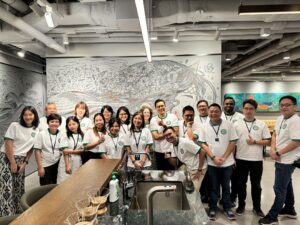
I was most surprised by how tightly knit and supportive the GPS community is. I was a student during the height of COVID-19, a time defined by social distancing, yet the bond among the cohort was incredibly strong.
Everyone knew everyone. It wasn’t just about networking; it was a genuine culture of helping one another with job hunting, assignments and exam prep. For international students especially, studying in a foreign country can be daunting, but GPS provided an inclusive, safe environment that encouraged us to explore the culture. That sense of camaraderie has turned into a long-term professional network that I know I can rely on.
If you could go back, would you make the same decision to attend GPS? Why?
Yes, without hesitation. Aside from the generous financial support I received, the rigorous academic training was transformative. The program forces you to adopt a structured, systematic way of solving problems, and you leave with a grasp of how data, policy, regulation and economics intersect.
“Financially, the return on investment was immediate.… The most significant change was that I became able to pivot sectors effectively.”
Whether you go into academia or the corporate world, the ability to think logically and back your arguments with rigorous data analysis sets you apart. GPS provided the perfect sandbox to develop these skills in a supportive, non-judgmental environment before applying them in high-stakes business settings.
What else would you tell a prospective student who is deciding whether to apply?
Think about where you want to wake up every day for the next two years. I can promise you that San Diego is one of the finest cities in the U.S. — offering safety, nature and a vibrant city life. The MCEPA program allows you to get a top-notch education and access to world-class faculty, all while living in a place that genuinely enhances your quality of life.
